There’s usually a specific moment when a family starts looking into home care. A fall that wasn’t serious but scared everyone. A phone call where Dad sounded confused about whether he’d eaten that day. A hospital discharge where the doctor mentioned, almost in passing, that she’d need some help at home going forward.
Michigan has more home care options than most states, which is genuinely useful. It also makes things harder to sort through when you’re already stressed and trying to figure out what your family actually needs.
At Cottage Home Care Michigan, we work with families in exactly these situations. This guide covers what home care actually means in Michigan, which programs pay for it, who qualifies, and what getting started looks like.
What Are Home Care Services in Michigan?
Quick Answer
Home care services in Michigan help seniors, adults with disabilities, and people recovering from illness stay in their own homes. Care can mean a caregiver helping with bathing and meals, a nurse managing wound care, or a home health aide sitting with someone who shouldn’t be alone. Funding comes through programs like MDHHS Home Help, MI Choice Waiver, Medicare, or private pay.
What Home Care Actually Covers
“Home care” is an umbrella term covering two broad categories:
Non-medical home care handles daily living tasks — things that become hard when you age or deal with a disability:
Bathing, grooming, and dressing
Meal preparation and feeding assistance
Light housekeeping and laundry
Medication reminders (not administration)
Shopping, errands, and transportation
Companionship and supervision
Skilled home health care brings clinical services directly to the home. A registered nurse, physical therapist, or occupational therapist visits regularly — covering wound care, IV therapy, post-surgery rehab, and chronic disease management.
Most families start with non-medical help. Over time, some need skilled services too. Michigan’s programs cover both, through different funding channels.
Who Uses Home Care in Michigan?
More people than you’d expect. Roughly 17% of Michigan’s population is over 65, and that number is still climbing. But home care isn’t only for seniors — the MDHHS Home Help program serves adults with physical disabilities, workers recovering from on-the-job injuries, and families with medically complex children in certain situations. The common thread: people who want to stay home, not move to a facility, and need some level of support to do that safely.
Michigan Home Care Programs Explained
Quick Answer
Michigan funds home care through several programs. The MDHHS Home Help Program is the most common — it pays for personal care services for Medicaid recipients. The MI Choice Medicaid Waiver offers broader services. Medicare covers short-term skilled care after a hospital stay. Private pay and long-term care insurance fill the gaps. Each program has different eligibility rules and benefits.
MDHHS Home Help Program
The Michigan Department of Health and Human Services (MDHHS) Home Help Program is Michigan’s main Medicaid-funded personal care program. It pays caregivers to help clients with Activities of Daily Living (ADLs) and Instrumental Activities of Daily Living (IADLs).
ADLs Covered
Bathing, dressing, grooming, eating, toileting, mobility, and transferring
IADLs Covered
Meal prep, laundry, light housework, shopping, and medication setup
Two things families often don’t know:
Approved hours range from minimal to up to 179.9 hours per month. In cases of severe need, MDHHS can authorize Expanded Home Help Services (EHHS) beyond that cap.
Minor children can qualify for Home Help — as long as care supplements (not replaces) normal parental care due to the child’s medical or physical impairment.
MDHHS Home Help Application Process
1
Verify Medicaid eligibility. You need active Michigan Medicaid. Apply through michigan.gov/mdhhs or MI Bridges at michiganbridges.org if you don’t have it.
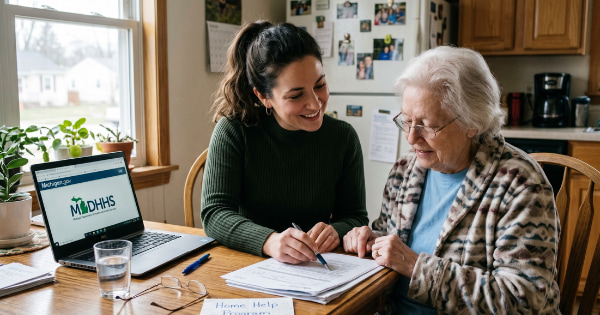
In-home assessment. An MDHHS worker visits your home to assess functional need and determine which ADLs and IADLs require help, then recommends monthly care hours.
4
Care plan and provider selection. MDHHS approves a plan and authorized hours. You then choose a home care provider — like Cottage Home Care Michigan.
5
Provider enrollment. Your chosen agency (or individual caregiver) must be an approved DHS home care provider enrolled with MDHHS.
EVV Compliance Note
Michigan requires all Home Help providers to use Electronic Visit Verification (EVV) through the CHAMPS Electronic Service Verification (ESV) system. Cottage Home Care Michigan is fully CHAMPS-certified and EVV-compliant — every care hour is accurately recorded. This protects clients, confirms care was delivered, and ensures uninterrupted Medicaid payments. When evaluating agencies, ask whether they are EVV-compliant. A provider that isn’t creates billing risk and potential gaps in your authorized hours.
Important: You can hire a family member as your paid caregiver through the Home Help program — with one exception: parents cannot be paid caregivers for their minor children. This is a program feature many families never hear about.
MDHHS Home Help Phone Number
Contact your local MDHHS county office for program questions — find it at michigan.gov/mdhhs/office-locations. The general MDHHS line is 1-800-292-5650. Ask specifically for the Adult Services unit to discuss Home Help.
MI Choice Medicaid Waiver
For Medicaid recipients who need a higher level of home and community-based services, the MI Choice Waiver covers things the standard Home Help program doesn’t — including adult day services, home modifications, and assistive devices. It’s an alternative to nursing home placement for people who would otherwise require that level of care.
Medicare Home Health
Medicare Part A and Part B cover short-term skilled home health care after a qualifying hospital stay. You must be homebound and need intermittent skilled nursing or therapy services under a physician’s orders. Medicare does not cover long-term non-medical home care.
Private Pay and Long-Term Care Insurance
If you don’t qualify for Medicaid, private pay is your path. Long-term care (LTC) insurance policies often cover home care — check your policy for daily limits and elimination periods. Veterans may be eligible for the Aid & Attendance benefit through the VA, which can offset home care costs significantly.
Who Qualifies for Home Care in Michigan?
Quick Answer
Most Michigan adults and children qualify for some form of home care. MDHHS Home Help requires active Medicaid and a functional need for ADL assistance. Medicare requires a physician’s order, homebound status, and a skilled care need. Private pay has no eligibility requirements. Veterans may qualify for VA benefits.
Eligibility at a Glance
Population
Relevant Program
Key Requirements
Medicaid adults (any age)
MDHHS Home Help
Active MI Medicaid + need for ADL/IADL help
Medicaid adults (high need)
MI Choice Waiver
Nursing-facility-level care need + Medicaid
Medicare beneficiaries
Medicare Home Health
Homebound + physician order + skilled need
Seniors (65+)
Medicare, Medicaid, or private pay
Varies by funding source
Adults with disabilities
MDHHS Home Help or MI Choice
Active Medicaid + functional limitations
Veterans
VA Aid & Attendance
Service-connected or income-based eligibility
Minor children
MDHHS Home Help
Active Medicaid + high-need care beyond typical parenting
Private pay clients
Any provider
No eligibility requirements — just able to pay
What MDHHS Looks At
When MDHHS does an in-home assessment for the MDHHS adult home help program, they evaluate:
Which ADLs the person can’t perform independently
Whether hands-on physical assistance is needed (not just reminders)
Whether a responsible relative is available to provide care
The person’s living situation and support network
The assessment determines monthly authorized hours. The average approval runs 70 to 100 hours per month, though this varies widely based on need.
Home Care vs. Home Health Care in Michigan
Quick Answer
“Home care” and “home health care” sound similar but mean different things. Home care is non-medical — a caregiver helps with daily tasks like bathing and meals. Home health care is medical — a licensed nurse or therapist provides clinical treatment at home. The cost, coverage, and qualifications differ significantly between the two.
If the main challenge is managing daily life — trouble getting dressed in the morning, cooking a safe meal, staying steady when moving around the house — that’s home care.
If someone left the hospital after a hip replacement, has a wound that isn’t healing, or needs physical therapy at home — that’s home health care.
Many families use both. Someone recovering from a stroke might get weekly physical therapy visits while a Cottage Home Care Michigan caregiver helps with personal care every morning. The two don’t conflict; they fill different gaps.
Home Health Care in Detroit: What Families Should Know
Quick Answer
Home health care Detroit families rely on includes both non-medical personal care and skilled clinical services. Wayne County has a high concentration of Medicaid recipients who qualify for MDHHS Home Help. Detroit’s diverse communities benefit from bilingual and culturally competent caregivers. Access varies by ZIP code — working with a statewide agency helps navigate coverage gaps.
Care in Michigan’s Largest City
Detroit is Michigan’s largest city and has one of the state’s highest concentrations of Medicaid-eligible adults. A few things worth knowing:
Language access matters. Detroit has large Arabic-speaking, Spanish-speaking, and Bengali-speaking communities. If your parent or loved one is more comfortable in their first language, ask agencies directly about their caregiver roster rather than assuming it’ll be worked out later.
Wayne County processing times. The Wayne County MDHHS office processes Home Help applications for the area. Wait times can run several weeks during busy periods — starting the process before things become urgent makes a real difference.
Rural vs. urban coverage. Detroit proper has more provider options than rural Michigan counties nearby. If your family member lives in Monroe, Sanilac, or Tuscola County, the agency’s service radius matters more than most families think to ask about upfront.
Plan for discharge before discharge day. Detroit-area hospitals — Henry Ford, Detroit Medical Center, and Beaumont — have social workers who coordinate home care after discharge. Ask about home care referrals before discharge day, not after.
At Cottage Home Care Michigan, we serve Wayne County and surrounding areas with caregivers who reflect the communities we’re part of.
Home Health Care Jobs in Detroit
Quick Answer
Home health care jobs in Detroit are among the most in-demand healthcare positions in Michigan. Caregivers, home health aides, and personal care attendants are needed across Wayne, Oakland, and Macomb counties. The work offers flexible hours, meaningful daily impact, and room to grow — with Michigan’s home care sector adding jobs steadily as the senior population grows.
Michigan’s 65+ population grew by more than 30% between 2010 and 2020 and is still climbing. That directly drives demand for caregivers, home health aides, and companion care workers, especially in metro Detroit.
Qualifications for most home care aide positions:
High school diploma or GED
CPR and first aid certification
Background check clearance
State-required caregiver training (typically 24–75 hours depending on role)
Valid Michigan driver’s license (often required)
In the Detroit metro area, home care aides typically earn $14–$20/hour depending on experience, specialty skills, and whether they work nights or weekends. Skilled nursing positions pay more.
Many Cottage Home Care Michigan team members started in entry-level aide roles and moved into care coordinator, scheduling, and field supervisor positions. The work builds real clinical and communication skills — and if you’re interested in nursing or social work later, it’s solid hands-on experience.
This work doesn’t get easier to replace with technology over time. Every person in our care is an individual with preferences, routines, and dignity. The people who do this job well already understand that.
Families choose Cottage Home Care Michigan because we match caregivers carefully, build real care plans around how someone actually lives, and keep families informed. We have direct experience navigating MDHHS Home Help funding and private pay arrangements across all 83 Michigan counties.
What Sets Our Care Apart
Thoughtful caregiver matching. We don’t assign whoever’s available. We look at personality, language, schedule, and specific care needs. A stable match means a more predictable routine — which matters especially for people with cognitive or physical challenges.
Care plans built around real life. When they wake up, what they eat, how they prefer to spend their time. The plan reflects the person, not just the diagnosis.
Family communication. We keep families in the loop whether they’re across town or across the country. Family members who aren’t local consistently tell us this matters more than anything else we do.
Medicaid navigation. Navigating Medicaid home care paperwork is genuinely complicated. Our team has been through the adult home help application process many times and can help families understand what to expect at the MDHHS assessment stage — not just after.
Flexible scheduling. Part-time, full-time, live-in, or overnight — built around real life, including shift work and school pickups.
Vetted, trained caregivers. Every caregiver passes a thorough background check and completes training before the first visit.
Common Mistakes Families Make When Choosing Home Care
Quick Answer
The most common mistakes are waiting too long to start, choosing an agency based on price alone, skipping the caregiver interview, and not understanding what insurance covers. Many families also don’t realize that Medicaid can pay for home care — meaning they pay out of pocket when they don’t have to.
Waiting for a crisis. The best time to set up home care is before it becomes urgent. Emergency searches lead to rushed decisions and fewer good options.
Assuming home care isn’t affordable. Medicaid covers home care for qualifying adults. If your family member has Michigan Medicaid, they may be entitled to free or low-cost care through the MDHHS Home Help program. Many families pay for months of care they didn’t have to.
Not asking about caregiver consistency. High turnover is disorienting, especially for seniors with memory loss. Ask agencies directly: how often do clients see the same caregiver?
Confusing home care with home health care. Hiring a home health aide when someone needs skilled nursing — or vice versa — creates real gaps in care.
Skipping the caregiver interview. A good agency will arrange for families to meet a caregiver before the first shift. If an agency doesn’t offer this, take note.
Ignoring geographic reach. Some agencies serve only specific cities or counties. If your loved one moves or has appointments across county lines, ask about coverage radius early.
Not clarifying backup care plans. What happens when a caregiver calls in sick? Ask every agency how they handle this.
Overlooking VA benefits. Veterans and their surviving spouses may qualify for the Aid & Attendance pension. Most people who qualify don’t know they’re eligible.
How To Get Started With Home Care
Quick Answer
Getting started involves three main steps: understand what care is needed, identify which programs fund that care (Medicaid, Medicare, private pay, VA), and contact a licensed Michigan home care agency. The process typically takes 1–4 weeks from first call to first caregiver visit, depending on the funding source.
Step-by-Step Checklist
1
Assess the situation
☐
What daily tasks does your loved one need help with?
☐
Is there a medical need (skilled nursing, therapy) or is it daily living support?
☐
Is care needed part-time or full-time?
2
Check insurance and program eligibility
☐
Does your loved one have Michigan Medicaid? → Apply for MDHHS Home Help
☐
Do they have Medicare? → Ask about Medicare home health coverage after a hospital stay
☐
Are they a veteran or veteran’s spouse? → Check VA Aid & Attendance eligibility
☐
Do they have long-term care insurance? → Review the policy’s home care benefit
3
Start the MDHHS process (if using Medicaid)
☐
Contact your local MDHHS county office or call 1-800-292-5650
☐
Ask to speak with Adult Services about the Home Help program
☐
Schedule the in-home functional assessment
☐
Gather documents: Medicaid ID, photo ID, proof of address
4
Contact home care agencies
☐
Get referrals from MDHHS, your doctor, or trusted neighbors
☐
Confirm the agency is a licensed DHS home care provider approved by MDHHS
☐
Ask about caregiver matching, backup coverage, and family communication
☐
Schedule a care consultation — this should be free
5
Meet your caregiver and start
☐
Meet the caregiver before the first shift
☐
Review the care plan together
☐
Set up a communication schedule with the agency
Ready to take the first step?
Call Cottage Home Care Michigan for a free consultation. We’ll walk through your situation and help figure out the right path — no pressure, no forms upfront.
The MDHHS Home Help program is a Michigan Medicaid benefit that pays for personal care services — bathing, dressing, meals, housekeeping — for adults and children who need hands-on help with daily tasks. It’s run by the Michigan Department of Health and Human Services through local county offices.
What is the MDHHS Home Help phone number?
There’s no single hotline. Contact your local MDHHS county office for program questions — find it at michigan.gov/mdhhs/office-locations. The general MDHHS number is 1-800-292-5650. Ask specifically for the Adult Services unit to discuss Home Help.
How do I apply for MDHHS Home Help?
Start at michigan.gov/adultservices or contact your local MDHHS county office. You’ll need active Medicaid, a functional need for ADL assistance, and a completed in-home assessment where a worker evaluates what daily tasks you need help with.
Can a family member be paid to provide home care through MDHHS?
Yes. Adult family members — including adult children, siblings, and other relatives — can be paid Home Help caregivers through the MDHHS program. Parents cannot be paid caregivers for their minor children through this program.
How many hours per month does MDHHS approve?
It depends on assessed need. The average approval is 70 to 100 hours per month, with a standard maximum of 179.9 hours. For higher needs, Expanded Home Help Services (EHHS) can go beyond that limit.
What is the difference between home care and home health care?
Home care is non-medical — a caregiver helps with daily tasks like bathing and meals. Home health care is medical — a licensed nurse or therapist provides clinical treatment (wound care, therapy, medication management) at your home. They serve different needs and are funded differently.
Does Medicare cover home care in Michigan?
Medicare covers skilled home health care (nursing, therapy) after a qualifying hospital stay, if you’re homebound and have a physician’s order. It does not cover ongoing non-medical home care like help with bathing or meals.
What is the MI Choice Medicaid Waiver?
The MI Choice Waiver is a Michigan Medicaid program that provides broader home and community-based services — including adult day programs, home modifications, and assistive technology — for people who would otherwise need nursing home-level care.
What is a DHS home care provider in Michigan?
A DHS home care provider is an agency or individual caregiver approved and enrolled with the Michigan Department of Health and Human Services to provide Home Help services to Medicaid beneficiaries. Approval requires meeting state qualifications and training standards.
How much does home care cost in Michigan without insurance?
Private pay rates for non-medical home care typically run $20–$30 per hour in Michigan, depending on the county, shift type, and level of care needed. Overnight and live-in rates vary. Skilled nursing visits cost more.
What counties in Michigan does Cottage Home Care serve?
We serve families across all 83 Michigan counties. Our Detroit office at 150 W Jefferson Ave, Suite P307 coordinates statewide coverage.
Southeast Michigan
Wayne, Oakland, Macomb, Washtenaw, Monroe, Livingston, St. Clair, Lapeer
Southwest Michigan
Berrien, Van Buren, Kalamazoo, Calhoun, Allegan, Barry, St. Joseph, Cass, Branch
Mid-Michigan / Lansing
Ingham, Clinton, Eaton, Shiawassee, Genesee, Saginaw, Bay, Midland, Isabella, Tuscola, and more
Can home care services be provided in assisted living facilities?
Yes. In Michigan, home care services — including MDHHS Home Help — can often be delivered in a client’s primary residence, which in some cases includes assisted living facilities or adult foster care homes (subject to program rules and facility policies).
What kinds of jobs are available in home health care in Detroit?
Common positions include personal care aide, home health aide, companion caregiver, certified nursing assistant (CNA), and care coordinator. Cottage Home Care Michigan regularly hires in the Detroit metro area. No clinical degree is required for most personal care positions.
How long does it take to get approved for MDHHS Home Help?
After your in-home assessment, approval typically takes a few weeks — sometimes longer in high-volume county offices. Starting the process before care becomes urgent is the single best thing you can do.
What happens if my regular caregiver is sick or unavailable?
A well-run agency maintains backup coverage. At Cottage Home Care Michigan, we coordinate substitute caregivers so clients aren’t left without support. Ask agencies specifically how they handle this — it’s one of the most important questions you can ask.
Can I get home care for a parent with dementia in Michigan?
Yes. Home care is frequently used to support people with Alzheimer’s disease and other forms of dementia. Care plans are built around their routine, comfort, and safety. Depending on the level of need, MDHHS Home Help, private pay, or the MI Choice Waiver may cover the services.
Conclusion
Home care is what makes staying home actually possible for most people — not a last resort, not a stopgap. It’s the thing that fills in where family, distance, and physical limitations leave a gap.
Michigan has solid programs to fund it. Most families who qualify for the MDHHS Home Help program don’t find out until someone walks them through it. That’s a real problem, and it’s fixable.
If your family is figuring this out right now, start with a conversation. You don’t need to have everything sorted before calling.
Call Cottage Home Care Michigan
Free consultation · All 83 Michigan counties · MDHHS Home Help experts















Discussion
Leave a Reply