Get Paid as a Family Caregiver in Michigan: Your Complete 2026 Guide to Family Caregiver Compensation
Most Michigan families never find out: you may already qualify for family caregiver compensation through Michigan Medicaid. If your loved one is on Medicaid and needs help with daily tasks, the state can pay you — the daughter, the granddaughter, the sibling who is already there — for the work you are already doing.
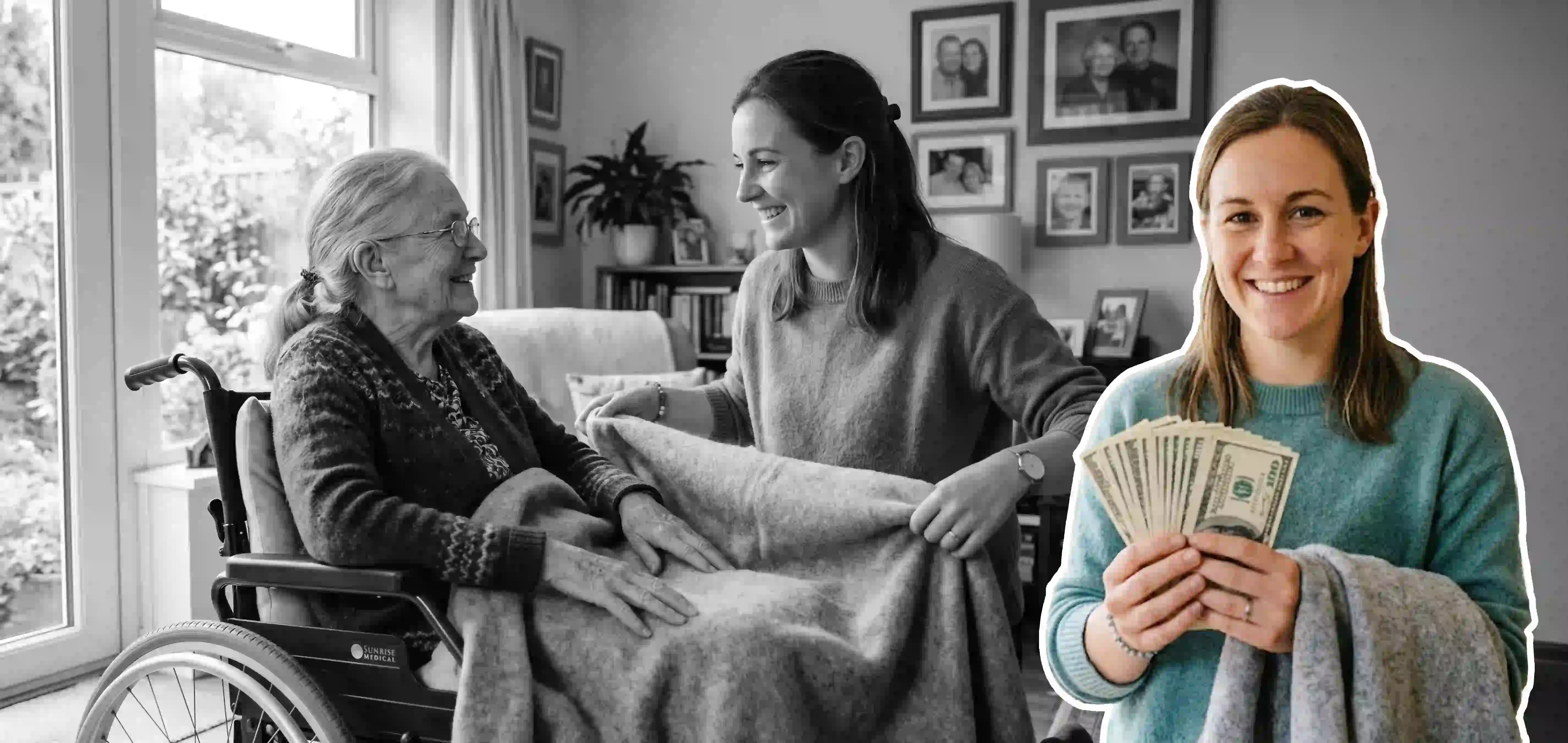
As of January 1, 2026, Michigan’s Home Help Program pays individual family caregivers $17.13 per hour. That’s a raise from 2025. Work with Cottage Home Care and earn up to $3,240 — with full support from enrollment to your first paycheck
Before you contact the state directly — read this first. Most families apply alone and earn $17.13/hr. Families who start with Cottage Home Care earn more money and get help in their own language. See how it works →
What Is Family Caregiver Compensation?
Quick Answer: Family caregiver compensation is money paid to a family member who provides daily hands-on care for a loved one at home — usually through a state Medicaid program. In Michigan, the main program is the Home Help Program, administered by MDHHS.
When most people hear “caregiver,” they picture a nurse or a certified aide. In Michigan, a family caregiver can be a daughter, an adult grandchild, a sibling, or a close friend. The program doesn’t check credentials. It checks whether the person being cared for trusts you.
The Michigan Medicaid Home Help Program is built around that: your loved one picks who helps them. That person registers with the state as a Medicaid provider and starts getting paid. The idea isn’t complicated. The paperwork is.
Getting paid for helping elderly parents or caring for a disabled sibling isn’t a gift from the state — it’s payment for real work. An outside aide costs $27,000–$54,000 a year for the same job. A nursing facility runs far more. The caregiver compensation program exists because families do this work whether or not they’re compensated for it. The ones getting paid are simply the ones who found out this program existed.
Michigan has 1.28 million unpaid family caregivers, according to Paid.care. Their work is worth an estimated $15.3 billion a year statewide. Most of them have no idea a payment program exists.
Who Qualifies as a Paid Caregiver? (Caregiver Eligibility)
Quick Answer: You qualify as a paid family caregiver in Michigan if you are 18 or older, not the care recipient’s spouse, able to pass a background check, and willing to enroll in CHAMPS — Michigan’s Medicaid provider enrollment system. Becoming a paid caregiver for a family member in Michigan requires no healthcare experience or prior training.
Caregiver eligibility under the Michigan Home Help Program requires:
- Age: At least 18 years old
- Relationship: Adult child, grandchild, sibling, niece, nephew, other relative, or friend — all qualify. You don’t need to be related by blood or marriage.
- Who cannot be paid: A legal spouse cannot be paid as a caregiver for their partner. A parent cannot be paid to care for a child under 18. Both exclusions are firm.
- Criminal history: You must pass a state background check. Certain crimes — felonies, convictions related to patient abuse or neglect, or Medicaid fraud — will disqualify a caregiver. A minor criminal record is not an automatic disqualifier, but serious offenses are.
- CHAMPS enrollment: You must register in Michigan’s Community Health Automated Medicaid Processing System (CHAMPS) as an “Atypical provider.” No healthcare credentials are needed. CHAMPS is the state’s payment platform — your approval there is what puts checks in your name.
- EVV compliance: As of April 2026, all Home Help caregivers must use Electronic Visit Verification (EVV) — usually through the HHAeXchange+ app or telephony system — to clock in and out at every visit. This is how services get verified and payment gets triggered.
Most of what families assume will disqualify them turns out not to be a real barrier:
What You Don’t Need to Qualify (Common Myths, Cleared Up)
- No healthcare experience required. No nursing license, no CNA certification, no formal training. If you can do the work, you can apply.
- No upfront costs. CHAMPS enrollment is free. There are no application fees.
- A minor criminal record doesn’t automatically disqualify you. Only specific offense types disqualify caregivers. Ask an MDHHS caseworker or home care agency what applies to your situation.
- You don’t need to quit your other job. Home Help hours can fit around your existing schedule.
Who Can the Care Be For?
Quick Answer: The care recipient must be a Michigan Medicaid beneficiary who needs help with daily living activities. Any age qualifies — this is not just for seniors.
The Home Help Program isn’t only for the elderly. That’s one of the most common wrong assumptions families bring to this.
Your loved one can be any age. They need a doctor to confirm they need help with daily tasks, and they need to be on Michigan Medicaid — or be eligible for it.
The person receiving care must:
- Be enrolled in Michigan Medicaid — or qualify for enrollment
- Need hands-on help with at least some activities of daily living (bathing, dressing, grooming, mobility, meals, or housekeeping)
- Have a licensed medical provider — doctor, nurse practitioner, physician assistant, or licensed therapist — complete the MDHHS-6200 form confirming their need for Home Help services
Note on the form: The MDHHS-6200 replaced the old DHS-54A form effective 2026. If someone hands you the old version, ask for the current one. Submitting the outdated form delays your medical certification and pushes back your start date.
What about dementia? If your loved one lives with Alzheimer’s or another form of dementia, they may qualify — but this part matters. The Home Help Program covers hands-on assistance. If most of what your loved one needs is supervision — someone nearby to prevent wandering, for example — those hours probably won’t be approved. If they need both hands-on help and significant monitored oversight, the MI Choice Waiver may be a better fit, though it takes longer to access and has limited open slots.
One note for families in live-in caregiving situations: Michigan’s MI Choice Waiver is expected to add Structured Family Caregiving (SFC) in July 2026, which would pay a daily stipend to live-in family caregivers. It’s still a proposal as of June 2026, but worth asking MDHHS about when it launches.
How Much Do Paid Family Caregivers Earn in Michigan in 2026?
Quick Answer: As of January 1, 2026, individual family caregivers through Michigan’s Home Help Program earn $17.13 per hour. Caregivers working through a licensed home care agency typically earn $17 or more, plus benefits like paid sick leave.
| Caregiver Type |
Hourly Rate (2026) |
Notes |
| Individual (self-directed, paid directly by state) |
$17.13/hr |
$13.73 state minimum wage + $3.40 mandated pass-through (Public Act 337 of 2018) |
| Working through a licensed home care agency |
Typically $17+/hr* |
Caregiver is a W-2 employee of the agency, not paid directly by the state |
| Cottage Home Care |
Up to $17-$18/hr* |
Caregiver is a W-2 employee of the agency, not paid directly by the state |
*A note on the agency caregiver rate: Michigan law only requires agencies to pay caregivers at least the state minimum wage ($13.73/hr). No state rule mandates they match the individual caregiver floor of $17.13/hr. The $27.00/hr that MDHHS pays to the agency covers both the caregiver’s wage and agency overhead — payroll taxes, workers’ compensation insurance, CHAMPS compliance, case management, and administration. In practice, most licensed Michigan agencies pay $17/hr or more because caregivers have options and agencies compete for them. But that higher rate reflects market pressure, not a regulatory floor. Ask any agency you consider what their specific pay rate is before enrolling.
If your loved one qualifies for 180 approved hours per month, the maximum monthly individual caregiver pay is approximately $3,083 ($17.13 × 180 hours). Through Cottage Home Care at $18/hr, that's up to $3,240/month — the same hours, more take-home pay.
Working through an agency means someone else handles the administrative load. Because agencies receive the $27.00 provider rate from Medicaid, they can:
- Handle all CHAMPS enrollment, renewals, and compliance
- File your payroll taxes automatically
- Enroll you in paid sick leave under Michigan’s Earned Sick Time Act (effective February 2025)
- Assign a dedicated case manager and nurse to support you
- Manage EVV submissions so you don’t miss the weekly payment window
If you go the individual route, all of that falls on you. The pay is real, but so is the paperwork.
Several sites still list 2024 or early 2025 rates — $12.25, $15.88 per hour. Those numbers are outdated. Medicaid caregiver compensation in Michigan increased again January 1, 2026. The official individual caregiver rate confirmed in MDHHS’s Adult Services Manual is $17.13/hour.
How to Become a Paid Family Caregiver in Michigan (Step-by-Step)
Quick Answer: The four core steps are: confirm Medicaid eligibility → get the MDHHS home assessment → enroll in CHAMPS and pass your background check → start providing care with EVV verification.
Step 1: Confirm your loved one’s Medicaid status
No Michigan Medicaid = no Home Help Program. If your loved one isn’t enrolled yet, don’t stop here. Many seniors and people with disabilities qualify and just haven’t applied. An MDHHS caseworker or a licensed home care agency can help.
If Medicaid is already active, you’ve cleared the biggest hurdle.
Step 2: Contact your local MDHHS office for a Home Help assessment
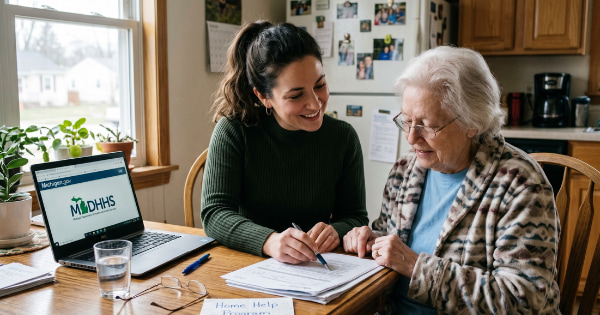
Call the MDHHS office in your loved one’s county and request a Home Help assessment. An MDHHS social worker visits the home, reviews what care is needed, and sets the number of approved hours per month.
Bring or have ready:
- Your loved one’s Medicaid number
- The name and contact info of their doctor or clinic
- A written list of tasks they can no longer do independently
- Any recent hospital or rehabilitation discharge paperwork
- The name of the family member who wants to be the paid caregiver
- Your loved one’s mailing address (Home Help payments are dual-party checks issued to both the client and the caregiver)
Step 3: Get the MDHHS-6200 medical certification form completed
A licensed medical provider — physician, nurse practitioner, PA, or licensed therapist — must sign the MDHHS-6200 form to confirm your loved one’s medical need for home care services. It is not a general doctor’s note. It must be the specific state form.
Step 4: Complete your CHAMPS enrollment
Create a MiLogin account at michigan.gov, then complete the CHAMPS Provider Enrollment application as an Atypical provider. The criminal history check happens here. Your enrollment becomes effective on the date you submit your application — or you can request a retroactive start date.
Do not provide care expecting payment before CHAMPS is approved. This is the single mistake that costs Michigan families the most money.
Step 5: Set up EVV and start providing care
Once CHAMPS is approved and your authorized hours are set, you can begin care. Clock in and out using the HHAeXchange+ app or telephony system for every visit. Submit your Electronic Service Verification (ESV) by Friday at 1:00 PM ET each week. A late submission delays payment by a full week.
How long does this take? It depends on whether Medicaid is active, how quickly the MDHHS-6200 comes back from the doctor, when the home assessment gets scheduled, and how fast you move through CHAMPS. Families with everything ready can typically begin paid care within 4–8 weeks. An agency doing this every week will move faster than a family figuring it out for the first time.
What’s Covered — and What Isn’t
Quick Answer: The Home Help Program pays for hands-on physical help with daily activities. It does not cover passive supervision, reminders, driving, or general household maintenance.
Tasks typically approved for Home Help:
- Bathing, showering, personal hygiene
- Dressing and undressing
- Grooming (hair, nail care, shaving)
- Toileting and incontinence care
- Mobility assistance — getting in and out of bed, chairs, the car
- Meal preparation and feeding
- Medication administration
- Light housekeeping tied to the care recipient’s living area
- Grocery shopping
- Laundry
Tasks that are NOT covered:
- Being “on call” or nearby “just in case”
- Reminders and prompting without physical help
- General driving not connected to a specific care task
- Yard work, repairs, or general home maintenance
- Pet care
Dementia families run into this specifically. If your loved one mainly needs someone nearby for safety — not direct physical help — those supervisory hours won’t count toward approved time. The hands-on tasks still qualify. Pure watch-and-wait doesn’t.
If the care your loved one needs goes beyond what Home Help covers, ask MDHHS about the MI Choice Waiver program. It covers a broader range of home and community-based services. The tradeoff: limited capacity, and a longer wait to get in.
Common Mistakes That Delay Payment
Quick Answer: The two most expensive mistakes are starting care before CHAMPS is approved, and missing the weekly EVV submission deadline. Both cost you real money.
Mistake 1: Providing care before CHAMPS approval
The most common — and costliest. Three months of daily care means nothing if CHAMPS wasn’t approved first. You won’t be paid for any of it. Wait for written confirmation before starting.
Mistake 2: Using the old DHS-54A form
Replaced by the MDHHS-6200 in 2026. If your doctor hands you the old version, ask for the current one. Outdated paperwork delays your medical certification and your start date.
Mistake 3: Missing the Friday EVV deadline
The ESV/PSV window closes at 1:00 PM ET every Friday. One missed deadline = one week of delayed payment. Set a recurring calendar reminder Thursday night or Friday morning.
Mistake 4: Applying for MI Choice when Home Help is faster
MI Choice covers more, but Home Help gets you paid sooner. If Home Help covers what your loved one needs, start there. You can always reassess later.
Mistake 5: Assuming the spouse qualifies
Spouses cannot be paid caregivers under the Home Help Program. Full stop. If a husband wants to care for his wife through this program, it won’t work — but their adult child or another relative can apply instead.
Mistake 6: Trusting outdated rate information
Several websites still show 2024 numbers. The official 2026 individual caregiver rate is $17.13/hour. Don’t let a wrong figure on someone else’s website talk you out of applying.
Your 10-Step Action Checklist
Quick Answer: Start with confirming Medicaid eligibility. Complete the assessment and CHAMPS enrollment before providing any paid care. Set up EVV early.
Confirm your loved one has — or qualifies for — Michigan Medicaid
Contact the MDHHS county office to request a Home Help assessment
Gather documents: Medicaid ID, doctor contact, list of care tasks, recent hospital/rehab papers
Ask the doctor or NP to complete the MDHHS-6200 form (not the old DHS-54A)
Create a MiLogin account at michigan.gov
Complete the CHAMPS Provider Enrollment application
Pass the criminal history check
Receive CHAMPS approval confirmation before starting care
Download and set up the HHAeXchange+ app for EVV compliance
Set a recurring Friday reminder to submit ESV by 1:00 PM ET
If any of these steps feel like too much — especially CHAMPS enrollment and EVV setup — a licensed home care agency can handle most of it for you.
Frequently Asked Questions
Can I get paid to take care of my mother in Michigan?
+
If your mother is enrolled in Michigan Medicaid and needs daily hands-on help, there’s a good chance you qualify. The Home Help Program covers this situation directly. You must be 18 or older, pass a background check, enroll in CHAMPS, and not be her legal spouse.
How do I get paid to take care of a family member in Michigan?
+
The answer depends on one thing: does your family member qualify for Michigan Medicaid? If yes, you can become a paid caregiver through Michigan’s Home Help Program. Enroll in CHAMPS as an Atypical provider, pass a background check, and get authorized through your local MDHHS office. See the step-by-step section above for the full process.At 180 approved hours, that's up to $3,240 per month through an agency.
Can I get paid to take care of my grandma in Michigan?
+
Adult grandchildren qualify under Michigan’s Home Help Program — same eligibility requirements as an adult child. The family relationship rules don’t draw a distinction there.
Can I get paid to care for elderly family members if they’re not on Medicaid yet?
+
You can run both applications at the same time. A lot of seniors qualify for Medicaid but have never applied. An MDHHS caseworker or home care agency can walk you through both.
How much do paid family caregivers earn in Michigan in 2026?
+
Individual caregivers working directly through the state earn $17.13 per hour. Caregivers employed through a licensed home care agency typically earn $17 or more per hour, plus benefits including paid sick leave.
Can a spouse be a paid caregiver in Michigan?
+
Spouses are excluded from the program — that’s a firm rule, not a grey area. Parents of patients under 18 are also excluded. Everyone else — adult children, grandchildren, siblings, other relatives, close friends — can apply.
How many hours can a family caregiver get paid for each month?
+
The Home Help Program approves up to 180 hours per month based on the care recipient’s assessed needs. Some individuals may qualify for additional hours depending on their level of need.
What does caregiver eligibility mean, exactly?
+
For the caregiver: must be 18+, not the spouse or parent of a minor, able to pass a background check, and complete CHAMPS enrollment. For the care recipient: must be a Michigan Medicaid beneficiary with documented need for hands-on daily care, supported by a completed MDHHS-6200 form.
What is CHAMPS, and why is it so important?
+
CHAMPS (Community Health Automated Medicaid Processing System) is Michigan’s Medicaid provider enrollment system. No CHAMPS approval = no payment, regardless of how much care you provide. Enrollment is free and requires no healthcare credentials. It just takes time to process.
Can I get paid to care for a family member with dementia?
+
Possibly. If your loved one needs hands-on help with bathing, dressing, meals, mobility, or medication management, those tasks qualify. Supervisory hours — watching them to prevent wandering, for example — typically don’t count toward approved time. If most of the care is supervision-based, ask MDHHS about the MI Choice Waiver.
What is the difference between the Home Help Program and MI Choice Waiver?
+
Home Help is faster to access and covers most families’ needs. MI Choice covers a broader range of services and works better for complex care situations — but it has limited capacity and longer wait times. If Home Help fits, start there.
What is the new MDHHS-6200 form?
+
The medical certification form that replaced the old DHS-54A in 2026. A licensed medical provider must complete it to confirm your loved one’s need for Home Help services. If anyone directs you to the DHS-54A, ask for the MDHHS-6200 instead.
You’ve Been Showing Up. It’s Time to Get Paid for It.
The care you’re giving already has dollar value. Anyone who’s priced out home aides or nursing facilities knows what that number looks like.
Michigan’s Home Help Program was built to pay family members for exactly this work. The 2026 rate is $17.13/hour direct through the state. You can get paid to take care of your loved one at home — either way. Go direct and the paperwork is yours to manage. Work through a licensed agency and you earn more, with CHAMPS enrollment, EVV compliance, and payroll handled for you.
The enrollment process has real steps, and one wrong move — like starting care before CHAMPS is approved — can wipe out weeks of pay. That’s where most families get stuck.
Cottage Home Care has been doing this for Michigan families for a long time. application, EVV setup, payroll — every form, every deadline. You focus on care. We handle the paperwork.
Why Michigan Families Choose Cottage Home Care
$17–$18 /hr
Competitive pay up to $18/hr — with payroll, taxes, and compliance handled.
The direct state individual rate is $17.13/hr. Cottage Home Care caregivers earn $17–$18 per hour. Same program, better take-home — plus everything handled for you.
Cottage Home Care is a licensed home care agency that has helped families get paid for caregiving since 1992. We don’t just process your paperwork — we give you every type of support you need, from your first call to your last renewal.
- Higher pay, same program. $17–$18/hr versus $17.13/hr direct. On a 180-hour month, that's up to $3,240 with us versus $3,083 direct — $157 more in your pocket, every month.
- All-type support, start to finish. CHAMPS enrollment, background check coordination, EVV setup through HHAeXchange, weekly ESV submissions, payroll, taxes, renewals — we handle every step so you can focus entirely on your family.
- Faster approval. Our team knows every MDHHS county office in Michigan. Families working with us move through approval faster than those navigating it alone for the first time.
- Payroll and taxes, handled. Direct deposit, automatic tax withholding, and your Michigan Earned Sick Time Act benefits — all set up for you from day one.
- A dedicated coordinator who stays with you. Renewals, re-certifications, form changes, and payment issues — we don’t disappear after your first check arrives.
Whatever language you speak at home — we speak it too.
Our team has staff who can communicate in many languages — Spanish, Bengali, Hindi, Arabic, Haitian Creole, Russian, Polish, and more. If English isn’t your first language, that is not a barrier here. Call us and we will connect you with someone on our team who speaks your language.
No matter where your family is from, no matter what language you are most comfortable in — you deserve to understand every step of this process clearly. We make sure you do.
Can’t find your language? Call us anyway. We will find a way to help.
Most families who call us are already providing daily care. They just haven’t been paid yet. The eligibility check takes less than five minutes — no cost, no commitment — and we can usually tell you the same day whether you qualify and what your hourly rate would be.
Serving families since 1992 · 15,000+ caregivers across 23+ states · No fees. No pressure. Just answers.
Sources: Michigan Department of Health and Human Services (MDHHS) Adult Services Manual 2026, MDHHS CHAMPS Individual Caregiver Guidelines, Michigan Home Care Association of America, Michigan Medicaid Provider Enrollment — MDHHS 2026.
Last updated: June 2026 | Reviewed by Cottage Home Care Michigan Care Coordination Team
|
|











Discussion
Leave a Reply