Finding the right home care agency in Michigan is one of the most meaningful decisions a family will ever make. Whether your loved one lives near the shores of Traverse Bay, in the heart of Detroit, in the shadow of the Big House in Ann Arbor, or in a quiet township in the Upper Peninsula — they deserve care that is trustworthy, culturally aware, and built around their life.
This guide walks you through every step: from identifying care needs and navigating Michigan Medicaid, to the questions that reveal whether an agency truly cares — or just says it does. We also share insider knowledge on the MDHHS Home Help program that most agencies simply do not know.
Cottage Home Care has been in the home care industry since 1992 — Michigan's trusted partner for
Medicaid Home Help,
private care, and consumer-directed family caregiver services, serving all 83 counties with multilingual, culturally matched caregivers.
Why aging in place in Michigan requires the right partner
Over 1.8 million Michigan residents are aged 65 and older. Most of them want to age in place — remaining in the comfort of their own homes rather than transitioning to an assisted living facility. Research consistently shows that aging in place supports better emotional well-being, reduces hospital readmissions, and preserves independence for longer.
But aging in place only works with the right support. A reliable home care agency provides far more than physical help with bathing or meal preparation. The best agencies deliver person-centered care — a philosophy rooted in honoring each client's personal values, cultural background, language, and lifestyle preferences. They also protect the client's social well-being by providing companionship, connection, and continuity.
Michigan's home care landscape includes national franchise chains that opened recently alongside deeply rooted local providers. We have been in the home care industry since 1992 — through every regulatory change from Lansing, every MDHHS policy update, and every shift in how Medicaid funds home care. That experience is not just history. It is expertise your family can rely on.
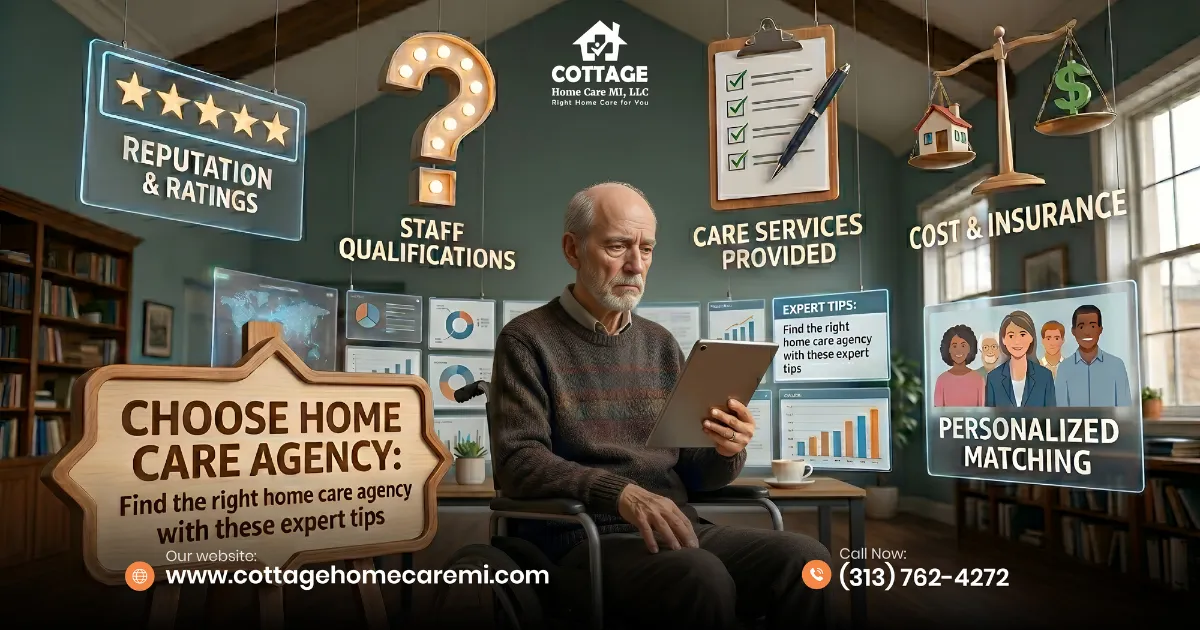
8 steps to choosing the best home care agency in Michigan
-
Define care needs
ADLs, IADLs, dementia, post-surgery, social well-being
-
Check Medicaid eligibility
Home Help vs Medicare — the Michigan difference
-
Verify credentials
CHAMPS certified, licensed, insured, background-checked
-
Confirm services
Personal care, meal prep, respite, 24-hour care
-
Read real reviews
Testimonials, local reputation, family stories
-
Understand costs
Medicaid vs private pay, rates, insurance options
-
Conduct the interview
Ask the questions that reveal true quality
-
Plan for transitions
Hospital discharge, snowbird seasons, evolving needs
Step 1: Define what care your loved one truly needs
Before contacting any agency, take time to map out your loved one's needs across three dimensions: physical, emotional, and social.
- Activities of Daily Living (ADLs): bathing, dressing, grooming, toileting, transferring, mobility assistance
- Instrumental Activities of Daily Living (IADLs): meal preparation, light housekeeping, laundry, medication reminders, shopping and errands
- Social well-being: companionship, conversation, accompaniment to community outings, support for hobbies
Also consider condition-specific needs — dementia care, Alzheimer's care at home, stroke recovery home care, post-surgery recovery, or palliative home care. A skilled agency matches caregivers to these specific requirements rather than sending whoever is available.
"We helped a daughter in Grand Rapids become her mother's paid caregiver through the Michigan Medicaid Home Help program. They stayed together in the home they had shared for over 50 years. The daughter received proper wages, professional training, and full support from our team — and the mother never had to leave the place she loved most."
— Anonymized family story, Cottage Home Care MI
Step 2: Understand Michigan Medicaid vs Medicare for home care
The single most common source of confusion for Michigan families is the difference between skilled nursing care (Medicare) and non-medical personal care (Medicaid). Here is the clear distinction:
- Medicare covers short-term skilled nursing and physical therapy following a hospitalization — not long-term personal care
- Michigan Medicaid, through the MDHHS Home Help Program, covers ongoing non-medical personal care for adults with physical or cognitive limitations
- To qualify, a client must have active Medicaid and a physician-certified need for help with ADLs (via Form MDHHS-6200)
| Feature |
Michigan Medicaid Home Help |
Private Pay |
| Who pays |
State of Michigan (MDHHS) |
Client / family out-of-pocket |
| Eligibility requirement |
Active Medicaid + physician certification |
None — open to all |
| Services covered |
Authorized ADLs & IADLs only |
Fully customizable care plan |
| Hours available |
State-authorized "Time and Task" hours |
Unlimited — as needed |
| Can family be paid |
Yes — through consumer-directed model |
Yes — through agency employment |
Cottage Home Care MI is fully Medicaid and CHAMPS certified — the gold standard of Michigan home care compliance that many smaller agencies fail to maintain. We handle the entire enrollment process for your family.
Step 3: Verify credentials and caregiver screening standards
CHAMPS certification is not a checkbox — it is a comprehensive commitment to compliance that requires ongoing maintenance, revalidation, and alignment with MDHHS standards. Ask any agency you consider whether they hold active CHAMPS enrollment. Many do not.
Beyond Medicaid credentials, a trustworthy agency will have:
- Multi-database criminal background checks: ICHAT, OTIS, OIG LEIE, and NSOPW
- CPR and First Aid certification prior to the first shift
- TB screening and physician health clearance
- HIPAA privacy training and infection control education
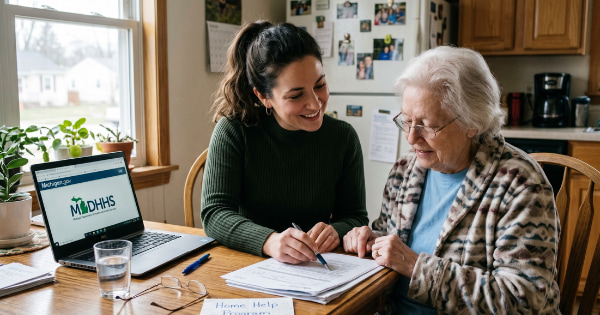
💡 3 insider tips for navigating MDHHS Home Help paperwork
Tip 1 — Get the MDHHS-6200 signed at the appointment:
When your loved one visits their doctor, bring the MDHHS-6200 Medical Needs Form printed and ready. Physicians who are asked to complete it by mail often delay for weeks.
Tip 2 — Call your local county MDHHS office directly:
Calling the Wayne County MDHHS office, Oakland County Health Division, or your local county office directly connects you to your assigned caseworker much faster.
Tip 3 — Reference your Area Agency on Aging:
Michigan is divided into AAA regions (like AAA 1-B). These agencies can often advocate on your behalf with MDHHS to accelerate case opening.
Step 4: Confirm the full range of services offered
The best agencies offer a complete continuum of care — from a few hours of weekly respite care to 24-hour live-in caregiver services. Cottage Home Care MI provides:
- Personal care
- Meal preparation
- Light housekeeping
- Pharmacy pickups
- Medication reminders
- Respite care
- Companion care
- 24-hour home care
Step 5: Check real client reviews and local reputation
Go beyond star ratings. Look for consistent feedback about caregiver reliability and communication. Watch video testimonials from Cottage Home Care MI families directly here.
Trust your instincts when you first call. Our team answers calls with genuine warmth — because we have built that culture since we entered the home care industry in 1992.
Step 6: Understand home care costs and payment options clearly
For Medicaid-eligible Michigan clients, the Home Help Program covers authorized care hours at no out-of-pocket expense. Key areas to clarify:
- Hourly rates and minimum shift requirements for private pay
- Whether the agency accepts long-term care insurance
- How family members are paid through Medicaid (W-2 employees)
Cottage Home Care MI handles all employer-side tax obligations — FICA, FUTA, SUTA, and workers' compensation — so families are protected from IRS liability.
Step 7: Conduct a thorough interview — and trust your gut
Key questions to ask during the interview phase:
- Is your agency CHAMPS enrolled and Medicaid certified in Michigan?
- What background checks do you run — including on family member caregivers?
- How do you match caregivers to clients culturally and linguistically?
- What is your backup staffing plan?
- Do you coordinate with our local MDHHS office and Area Agency on Aging?
Step 8: Plan for care transitions — hospital discharge, snowbirds, and evolving needs
Hospital-to-home: When a loved one is discharged from a Michigan hospital (like Corewell Health or Henry Ford), the first 72 hours are critical. We coordinate with discharge planners to ensure a safe transition.
The Michigan snowbird: Medicaid Home Help cannot travel across state lines. We manage administrative holds during winter so care resumes seamlessly in the spring.
Upper Peninsula logistics: Our consumer-directed model employs caregivers who already live near the client, solving the distance and weather challenges of the UP.
How to talk to a parent who is resistant to home care
Accepting help can feel like a loss of independence. Frame it as a way to stay home longer. Suggest starting small with just a few hours a week, and involve them in the caregiver selection process.
Common mistakes families make
- Choosing based on cost alone without verifying CHAMPS certification.
- Assuming all agencies accept Michigan Medicaid — many franchises do not.
- Not asking about backup staffing for missed or emergency shifts.
- Choosing an agency without multilingual or cultural matching.
Whether your loved one is in Traverse Bay, Wayne County, Muskegon, or the Upper Peninsula — Cottage Home Care MI is authorized to serve all 83 counties.
Frequently Asked Questions
Who qualifies for home health care services in Michigan?
Adults with active Michigan Medicaid who have a physician-certified need for assistance with Activities of Daily Living may qualify for the MDHHS Home Help Program.
Cottage Home Care MI verifies eligibility at no cost to your family.
Can a family member be paid to provide home care?
Yes. Under Michigan's consumer-directed model, family members (except legal spouses or parents of minors) can be paid through
Medicaid Home Help. Cottage Home Care MI handles all compliance requirements.
How much does in-home care cost in Michigan?
Medicaid-eligible clients pay $0 out-of-pocket for authorized Home Help hours. For private pay clients, costs vary by service level and hours.
Does Cottage Home Care MI serve rural Michigan?
Yes. Our consumer-directed model is uniquely effective in rural areas and the UP where traditional staffing agencies struggle with distance and seasonal road conditions.
Ready to find trusted home care in Michigan?
Get a free consultation with our care team today. We will verify your Medicaid eligibility, match you with the right caregiver, and handle every step of enrollment — at no cost to you.
Contact Us Now
Call: (313) 762-4272
150 W Jefferson Ave Suite P307, Detroit, MI 48226












Discussion
Leave a Reply